
On October 14, 2025, Claudia Jeanne da Silva Barros, Director of the Environmental Licensing Directorate (DILIC) at the Brazilian Institute of Environment and Renewable Natural Resources (IBAMA), led a delegation to visit the Chinese Research Academy of Environmental Sciences (CRAES) for exchanges and discussions on scientific and technological cooperation. Zhang Mengheng, Chief Engineer of CRAES, received the delegation.
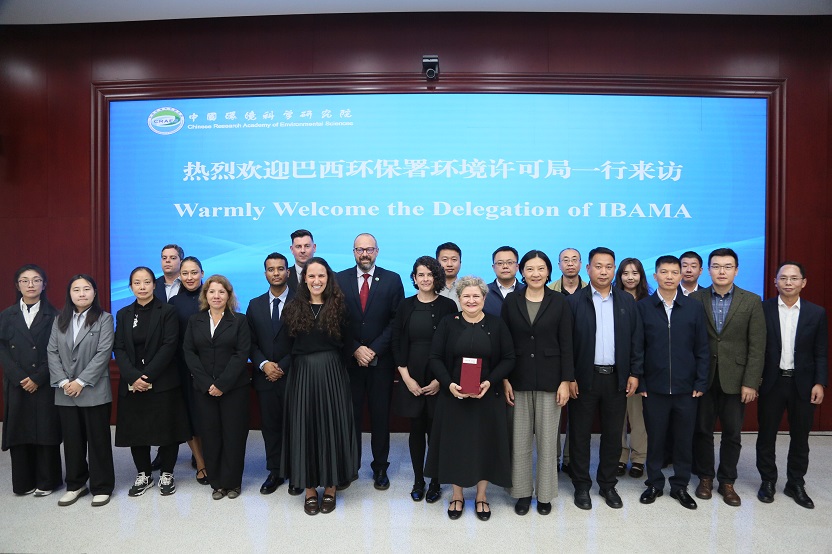
Zhang extended a warm welcome to Claudia Barros and her delegation, and presented a brief introduction of CRAES concerning its general profile, progress in scientific research and innovation, as well as its international cooperation initiatives. She noted that over the past 50 years since the establishment of diplomatic relations between China and Brazil, the two countries have become comprehensive strategic partners who work hand in hand for mutual benefit and win-win outcomes. The two sides share a high degree of consensus on major issues such as addressing global climate change and promoting sustainable development. Zhang emphasized that under the guidance of the governments of China and Brazil, CRAES is willing to carry out practical cooperation with the DILIC and join hands to contribute scientific and technological capabilities to ecological and environmental protection and sustainable development.
Claudia Barros expressed her gratitude to CRAES for the reception. She highly commended China's achievements in ecological civilization construction and sustainable development, and also spoke highly of CRAES' innovations in effectively supporting government decision-making through scientific research. She stated that the DILIC, as an institution under Brazil's Ministry of Environment and Climate Change, undertakes key responsibilities in environmental licensing, review, and supervision. In this role, it is willing to maintain continuous communication with CRAES, advance practical cooperation and join hands to address environmental challenges.
Researchers of CRAES gave a detailed presentations to the delegation on research progress in air pollution prevention and control, biodiversity conservation, environmental management and climate change response. In-depth discussions on natural resource protection, climate-resilient infrastructure development, environmental impact assessment systems and environmental standards flowed. They agreed to advance exchange and cooperation from environmental impact assessment of climate change and biodiversity loss.
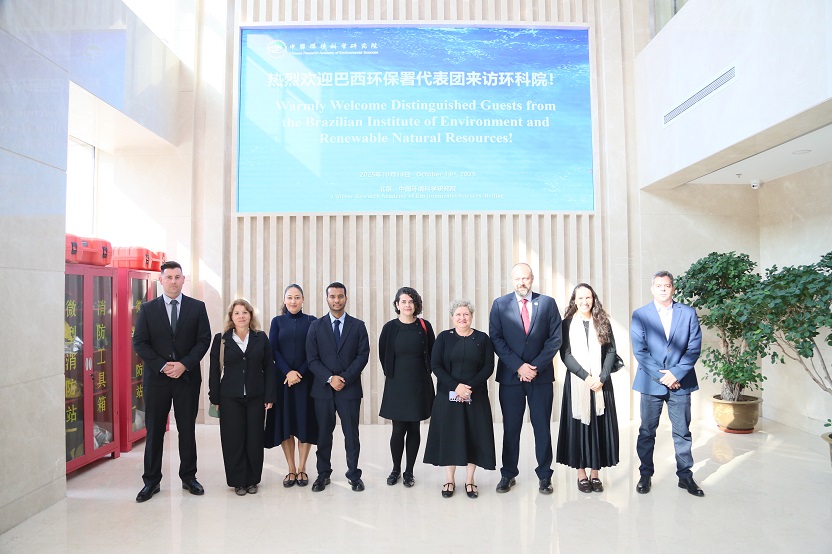
Prior to the meeting, the delegation visited CRAES' Comprehensive Experimental Building and the Supersite for Urban Air Comprehensive Observation and Research.
